


U-Boot slab is one of the most innovative technologies in the construction industry, helping to optimize structures and reduce execution costs. This system is especially welcomed in large civil projects and, due to its unique features, is the choice of many engineers and architects.
What is U-Boot?
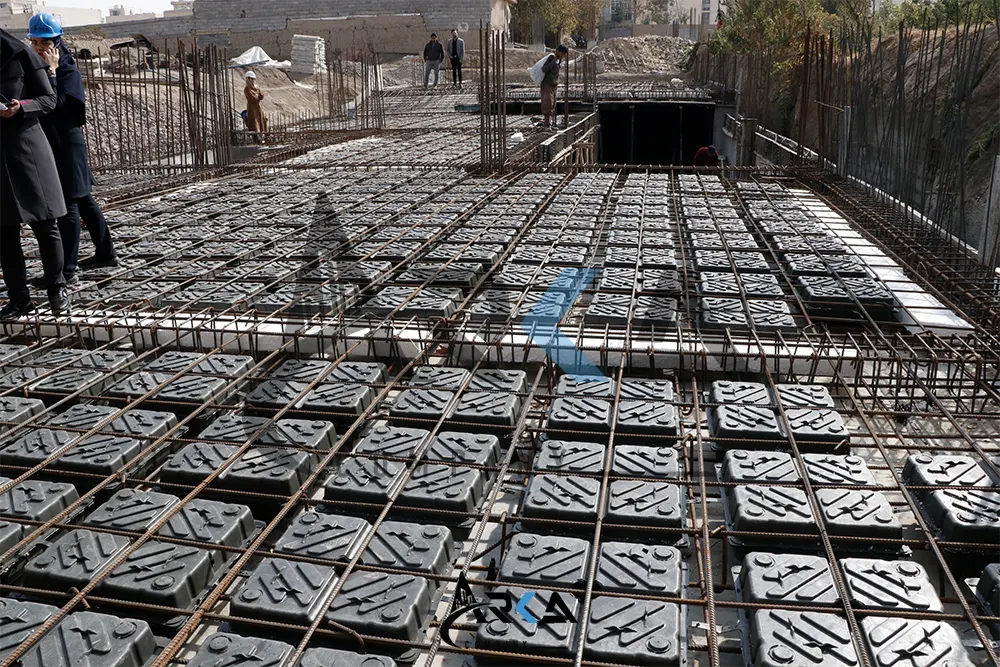
U-Boots are formwork used to create lightweight slabs in concrete buildings. These formworks enable the creation of hollow-core slabs, where a grid of perpendicular joists is enclosed by upper and lower concrete plates. In this way, the use of U-Boots greatly saves on concrete and rebar consumption. Additionally, U-Boots help construct slabs with large spans or under heavy loads without the need for suspended beams.
Material of U-Boot Formwork
U-Boot formwork is made of polypropylene, a lightweight, resistant, and recyclable type of plastic. This material is highly suitable for producing U-Boot formwork due to the following characteristics:
- Lightweight: Facilitates easy transportation and installation on construction sites.
- High Strength: Resistant to pressures from concrete and construction forces.
- Chemical Resistance: Resistant to chemicals and concrete corrosion.
- High Durability: Does not degrade over time under environmental conditions.
- Recyclability: Environmentally friendly due to its polypropylene structure and is recyclable.
These features make polypropylene an economical and sustainable option for producing U-Boot formwork in construction.
What is a U-Boot Slab?
A U-Boot slab consists of these same cubic or rectangular-shaped plastic formworks placed within the concrete. By creating voids inside the slab, these formworks not only help lighten the structure but also increase its strength and efficiency. The main goal of using a U-Boot slab is to reduce concrete and rebar consumption in slabs, ultimately creating a lighter and more resistant structure.

Execution and Design of U-Boot Slab
In executing a U-Boot slab, the floor is first fully formworked using metal or wooden formwork. Then, the rebar grid is installed according to the design dimensions and spacing. After that, the U-Boot formworks are arranged side by side using side tabs according to the specified intervals in the plan. In the next stage, the top reinforcement is installed, and if needed, shear or punch reinforcements are added as hooks.
Concreting in a U-Boot slab is done in two stages. The first stage involves pouring concrete up to the height below the formworks. Then, when the first layer begins to set and reaches a semi-solid state, the second-stage concreting is completed. Afterward, the concrete surface is leveled.
History of U-Boot Slab
The U-Boot system was first used in Europe, particularly in Italy. The initial goal of developing this technology was to reduce structural weight and increase the efficiency of concrete structures. Today, this technology has reached many parts of the world, including Iran, and is used in numerous projects.
Types of U-Boot Formworks
U-Boot formworks available in the Iranian market are divided into four main categories, each with its own specific features and applications:
Single U-Boot Formwork
This type of formwork has a simple, single-layer structure and is suitable for projects requiring structural lightening. It is used in residential buildings and small projects.
Double U-Boot Formwork
Double U-Boot formwork consists of two layers and is suitable for structures requiring higher strength. Due to providing greater rigidity and reducing concrete and rebar consumption, this type of formwork is widely used in industrial projects and high-rise buildings.
Modified (Inflatable) U-Boot Formwork
Modified U-Boot formworks are designed to address some issues with traditional formworks. These formworks feature an optimized design that increases slab stability and reduces potential risks during concreting. This type is used in specific and complex projects.
Polystyrene U-Boot Formwork
This type of formwork is made of polystyrene and is very popular due to its extremely low weight and insulating properties. Polystyrene formworks not only reduce structural weight but also act as thermal and acoustic insulators, and are employed in projects requiring these features.
Price of U-Boot Slab and Influencing Factors
The price range of U-Boot formwork depends on the following factors:
U-Boot Size
U-Boots are produced in various sizes. One of the most common production dimensions for U-Boots in the market is 52*52 cm with different heights. As the U-Boot height increases, its weight and consequently the raw materials used for its production also increase, leading to a higher price.
Raw Material Quality
One of the most important factors in determining the price of U-Boots is the quality of the raw materials used. The higher and more superior the quality of the raw materials, the higher the product price.
U-Boot Weight
The weight of U-Boot blocks is another determining factor in pricing. As the weight of U-Boots increases, their price also rises.
Production Cost
Costs related to producing U-Boot formworks, including manufacturing processes and energy consumption, also directly impact the final price.
Quality Test of Arka U-Boot Formworks
Arka Engineering Company, utilizing its knowledge, expertise, and skilled workforce, has been able to produce high-quality construction formworks. Below is a video of the quality test for U-Boot formworks:
Advantages of U-Boot Slab
The advantages of U-Boot slab include:
Engineering Design
Suitable for two-way slabs with the capability to execute spans up to 20 meters.
- Economic Efficiency: Reduced transportation costs and no need for cranes or false ceilings.
- Execution Speed: Quick and easy installation without the need for suspended beams, creating more usable height in floors.
Reduced Material Consumption
- Reduced concrete and rebar consumption due to the presence of plastic formworks.
- Savings in execution costs.
Reduced Structural Weight
Lightening the slab reduces the dead load on the structure, thereby optimizing the design of columns and foundations.
High Earthquake Resistance
Due to reduced structural weight and increased strength, U-Boot slabs perform better against seismic forces.
Space Optimization
Ability to create longer spans without the need for numerous columns.
Durability and Long Lifespan
Reduced cracking and increased concrete strength.
Reduced Maintenance Costs
High resistance and reduced need for frequent repairs.
Applications of U-Boot Slab
U-Boot slab is used in various projects:
- High-Rise Buildings: To reduce weight and increase structural efficiency.
- Industrial Halls: Due to the need for large, column-free spans.
- Multi-Story Parking Lots: Reducing the number of columns and optimizing parking space.
- Commercial and Office Centers: Improving space efficiency and reducing construction costs.
- Large Civil Projects: Such as bridges and infrastructure structures.
Stages of U-Boot Slab Execution
- Work Surface Preparation: Preparing the work surface and executing initial formwork.
- Installation of Bottom Rebars: Installing the bottom rebar grid on the formwork.
- Placing U-Boot Formworks: Arranging U-Boot formworks at specified intervals on the rebars.
- Installation of Top Rebars: Placing top rebars on the U-Boot formworks.
- Concreting: Concreting in two stages: first stage up to half the height of the formworks, and the second stage after the initial setting of the concrete.
- Curing of Concrete: Maintaining and caring for the concrete to achieve the desired strength.
Points in U-Boot Slab Execution
Proper Arrangement of Formworks: Formworks must be arranged carefully and at specified intervals.
Concrete Quality Control: The concrete used must be of high quality and have suitable workability.
Concrete Curing: Proper curing of concrete is essential to prevent cracking and increase its strength.
Close Supervision: Continuous supervision of all execution stages to prevent implementation issues.
Environmental Considerations
The use of U-Boot slab has a positive impact on the environment due to reduced consumption of concrete and rebar, as well as reduced construction waste. Additionally, the use of recyclable plastic formworks contributes to environmental sustainability.
Disadvantages of U-Boot Slab
- High Initial Cost: The cost of purchasing U-Boot formworks is higher compared to traditional systems.
- Need for Skilled Labor: Proper execution of this system requires experienced and skilled labor.
- Need for Special Equipment: Some execution stages require special equipment, such as advanced concrete pouring machinery.
What is a U-Boot Waffle Slab? Comparison of U-Boot Slab and U-Boot Waffle Slab
A U-Boot waffle slab is an advanced system used in building structure design. This system, using its specific formworks, reduces the weight of buildings while providing high strength. By reducing slab thickness and optimizing material use, the U-Boot waffle slab helps reduce costs and increase execution speed. This design is particularly suitable for tall buildings and large spaces requiring high resistance.
Both U-Boot waffle slabs and U-Boot slabs utilize similar systems to reduce weight and optimize material use, but their main difference lies in their design.
| Feature | U-Boot Waffle Slab | U-Boot Slab |
|---|---|---|
| Structure | Integrated and continuous formworks for increased strength | Separate formworks for optimal material use |
| Weight | Greater reduction in structural weight due to specific slab design | Weight reduction but with high flexibility |
| Strength | More resistant against intense loads | Suitable for open spaces with ordinary loads |
| Application | Primarily for tall buildings and heavy loads | Suitable for large and open spaces |
| Execution Speed | Faster due to integrated structure | Suitable execution speed but with separate formworks |
| Design Flexibility | Less flexible in design compared to U-Boot | More flexible for various designs |
Difference Between U-Boot Slab and Waffle Slab
U-Boot and waffle systems are two different methods for slab execution. Waffle slabs have a longer history, while U-Boot is considered a modern technology. Waffle slabs, due to using less concrete and rebar, are executed faster and have less weight; therefore, they impose less dead load on the structure. They also have lower execution costs compared to U-Boot. However, U-Boot is more suitable for large spans and structures resistant to earthquakes. The choice between these two systems depends on project requirements.
Difference Between U-Boot Slab and Cobiax Slab
U-Boot slab and Cobiax slab systems have technical differences. Although both systems have similar histories, U-Boot slab offers greater execution speed and material reduction, leading to reduced structural dead load. Additionally, due to optimized load distribution, this system has higher resistance to earthquakes. Finally, executing U-Boot slab is more cost-effective for builders due to its simple design and lower cost. The choice of each method depends on the project type and structural needs.
| Parameter | U-Boot Slab | Joist Block Slab | Cobiax Slab | Waffle Slab |
|---|---|---|---|---|
| Structural Weight | Lighter than joist block and Cobiax slabs | Heavier than U-Boot and Cobiax | Lighter than joist block, similar to U-Boot | Lighter than joist block, similar to U-Boot |
| Execution Cost | Higher due to use of special formworks | Relatively lower cost | Higher than joist block but less than U-Boot | Higher than joist block, similar to U-Boot |
| Strength | Resistant to point and distributed loads | Suitable resistance against distributed loads | High resistance against various loads | High strength, especially against point loads |
| Execution Speed | High speed due to prefabricated system | Medium speed, requires time for installation | Execution speed similar to U-Boot, with prefabricated formwork | Fast execution due to prefabricated formworks |
| Design Flexibility | Flexible in design and execution of complex plans | Flexible but more limited than U-Boot and Cobiax | Very flexible for various designs | Suitable for complex designs but requires high precision |
| Need for Skilled Labor | Requires skilled labor for formwork installation | Requires ordinary labor, simpler than U-Boot | Requires skilled labor similar to U-Boot | Requires skilled labor for precise formwork placement |
| Earthquake Resistance | Resistant against severe vibrations | Relatively resistant, but weaker than U-Boot/Cobiax | Resistant and stable against earthquakes | Highly resistant against earthquakes and lateral loads |
| Maintenance | Low maintenance required, formworks reusable | Low maintenance, but generally single-use | Low maintenance, similar to U-Boot | Low maintenance, but formworks require inspection |
| Suitability for Large Spaces | Suitable for large and open spaces | For large spaces, requires additional reinforcement | Suitable for large and open spaces | Suitable for large spaces with reduced need for columns |